And We Are Only in the First One
By Maris J. Ensing
Architect of Intelligent, Personalized Experience Systems
Themed entertainment has always advanced through invention. Mechanisms gave way to digital control. Projection and media transformed environments. Interactivity changed how guests engaged with stories. Artificial intelligence is the next leap in this lineage. But while AI appears everywhere, most people have only encountered the first ripple. True experiential intelligence will unfold in waves. Each wave will build on the last. And if we want to design the future rather than react to it, we must understand the structure forming beneath our feet.
I work with these systems daily, and see this sequence as a way to think about the next stages of experiential design. It is a perspective on the direction of the work, rather than a schedule or a statement that every stage is already deployed.
Different venues will adopt these capabilities at different times, according to their purpose and readiness.
Wave One: AI That Speaks
The first wave is linguistic intelligence. Large language models give AI the ability to interpret our instructions, write, translate, summarize, and collaborate. For the first time we can speak to our tools in natural language, and they respond with clarity and understanding.
Language tools can contribute to creative work, documentation, scripting and multilingual content. Retrieval-augmented generation, or RAG, connects a model to selected source material such as a curated Body of Knowledge. That grounding can support a controlled workflow, but source quality, permissions, output review and appropriate fallback behavior remain necessary.
Grounding alone does not guarantee factual correctness, safety or predictable answers. A venue needs to define and test the behavior on which it intends to rely.
These systems can use standard computing hardware with local or cloud components according to the design. Mad is demonstrating local intelligence as part of a direction in which important data stays at the venue. Each chosen data route, dependency and performance requirement must be established for the implementation.
Wave Two: AI That Understands
Language is powerful, but experiential intelligence requires more than speech. Attractions are not conversations. They are physical journeys. For AI to contribute meaningfully to that journey, it must develop an internal sense of reality. This is the second wave, and it arrives through World Models.
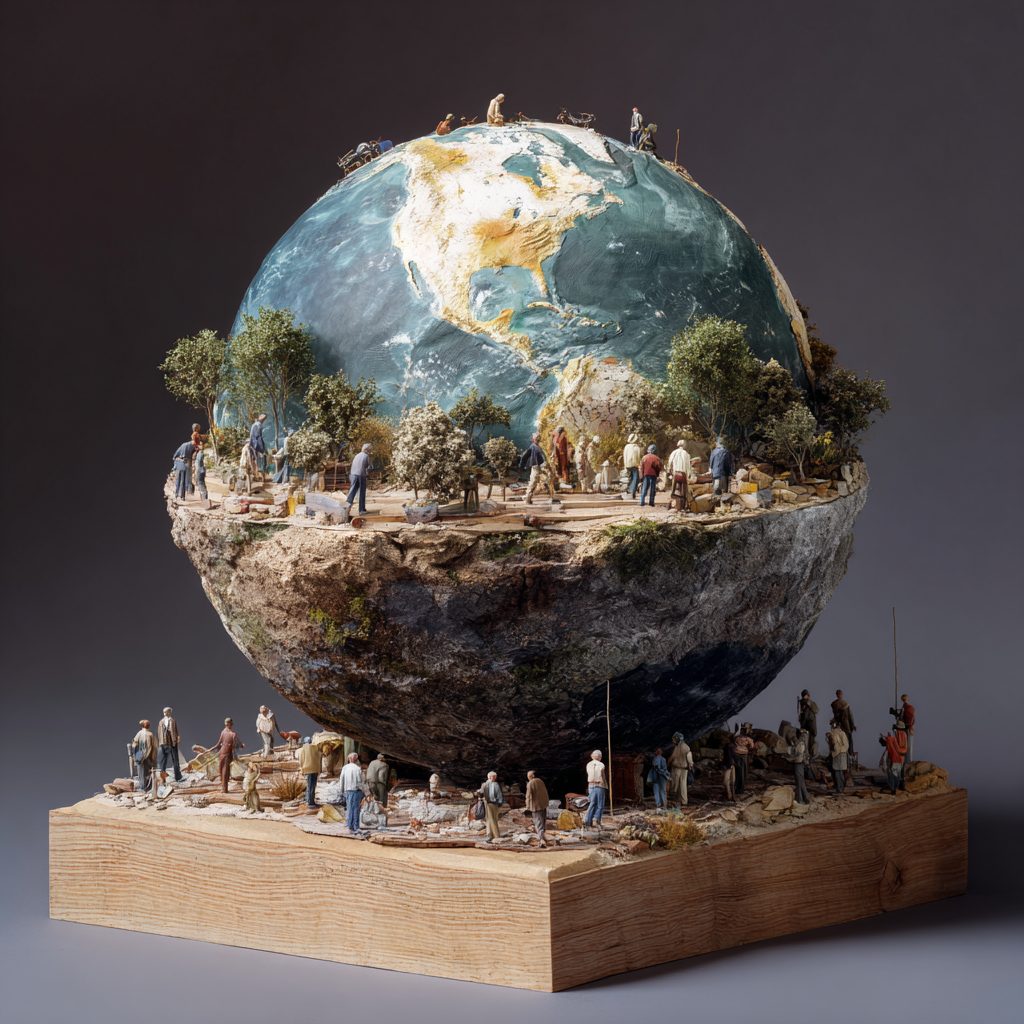
World models are a way to represent an environment and its changing state. In Mad’s WorldModel™ architecture, shared operational context is paired with governance and bounded authority. The model’s usefulness depends on the information actually available, its freshness and the scope of the connected systems.
But world models do not appear all at once. They grow through a sequence of invention. First, AI learns to interpret our instructions. Second, AI begins to interpret the environment through images, layouts, sensors, and spatial signals. Third, AI learns to track events across time rather than treating them as isolated inputs. Only then can a true World Model emerge.
This is the moment when AI begins to think in terms of physical intelligence.
Imagine a story that responds to a visitor’s chosen pace or interest. Spatial observations may help locate an interaction, but a pause does not by itself reveal why someone stopped. These are design possibilities to develop and qualify, with a clear distinction between supplied preferences and uncertain inference.
Wave Three: AI That Collaborates
A further direction is cooperation with a visitor’s personal AI assistant. Such an assistant might hold chosen preferences or access needs and help the visitor decide what to share. The availability of a compatible interface, the visitor’s consent and the venue’s permitted use would need to be established.
The proposed interaction would exchange a limited set of authorized attributes or requests. It would still be an exchange of information with privacy and trust requirements. The interface should specify the purpose, permissions, expiry, retention and withdrawal behavior.
A venue could then adapt a permitted experience using only the information the workflow requires. Whether that includes an identity, a visit-only session or optional membership persistence is a design choice. Local processing and data minimization must be implemented and checked, not inferred from the idea of a handshake.
This is the future of hyper-personalization at scale.
The Waves Together
- Wave One gives AI a voice.
- Wave Two gives AI understanding.
- Wave Three gives AI the ability to collaborate.
Together they form the blueprint for the next twenty years of experiential design. Not as replacements for creativity, but as new foundations for it. With these systems, experiences can notice, adapt, interpret, and respond. They become living environments rather than scripted machines.
Standard hardware and distributed compute can create options for future integration and incremental upgrades. Software, compatibility, processing capacity and support still determine the work involved. Existing legacy installations need a QuickSilver retrofit before selected AV++ capabilities are added.
Published architecture and working components give this direction concrete starting points. The complete set of proposed behaviors remains subject to integration, development and qualification.
Patents, architecture and implementation
Patents covering Mad technology include issued work and newer filings related to personalized experiences. Their public status and references are set out in the current IP record. The scope of a particular claim needs to be considered against the proposed implementation.
Cooperation between a personal AI and a venue system is a direction for development. A filing or publication is distinct from proof that a compatible, complete exchange has been deployed. That distinction helps owners and designers ask for the right demonstration.
We are not only imagining the future. We are creating it.
Closing Thought
Imagine entering an experience that understands your pace, your curiosity, your comfort, and your interests without ever knowing who you are. Imagine a venue where narratives unfold differently for each visitor because your personal AI and the environment are quietly working together. Imagine attractions that feel alive because they respond with intelligence rather than automation.
This is the horizon now coming into view. The warm up is ending. The real era of intelligent, personalized experiences is beginning. And we now have the tools, the architecture, and the vision to design it with intention.