AV SYSTEM DESIGN, ENGINEERING, INTEGRATION & SUPPORT

Audiovisual systems.
Designed for the experience.

Mad Systems designs, engineers and integrates complete audiovisual systems for museums, visitor centers, attractions and other physical environments. We can deliver conventional AV, or build on QuickSilver® to give the venue a computing foundation for capabilities that go far beyond conventional playback and control.

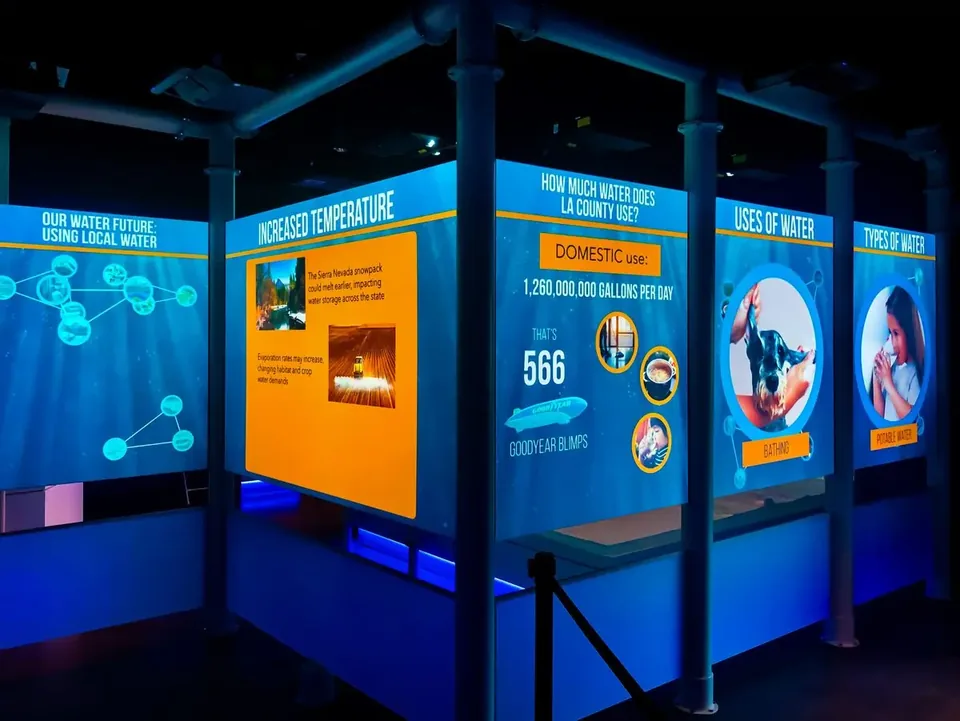
Digital water education exhibits at the Albert Robles Center in Pico Rivera, California
Albert Robles Center. A complete visitor experience that changes between English and Spanish.

DesignOrchestrateInspire

WHY MAD IS DIFFERENT

AV that does not paint you into a corner.

Build the AV you need now. Keep the compute architecture to do what comes next.

Conventional AV can become a collection of dedicated boxes, each bought for one purpose. It works, but it can leave a venue boxed into the decisions made for opening day. Mad can design and deliver conventional AV when it is the right answer. QuickSilver® gives us another approach: a compute architecture designed so the system can grow as the experience, the audience and the technology change.

QuickSilver® is the compute foundation for a new approach to AV. Core audiovisual functions run on standard computing and software, allowing sound, video, interactives and show control to share an extensible foundation instead of becoming isolated one-purpose systems. That makes current capabilities practical and gives future technologies somewhere to live.

On that foundation, Mad has developed a growing body of patented and patent-pending capabilities that take AV beyond conventional playback and control: personalized and targeted media, visitor context, accessibility, recognition, intelligent operation, advanced audio, spatial experiences, analytics and more. These are not isolated tricks. They are capabilities that can work together on an AV architecture designed to evolve.

01Compute, not a dead end

A standard compute foundation can be expanded in software instead of forcing the venue to rebuild its AV around every new idea.

02Capabilities can combine

Personalization, accessibility, show control, recognition, analytics and spatial experiences can share a connected foundation.

03Designed for what comes next

Current Mad capabilities can be selected now, and future technologies can be added where the project architecture supports them. Opening day does not have to be the end of the system's evolution.

THE AV++® FAMILY

The technology is already here. And it keeps growing.

QuickSilver® makes it practical to combine capabilities that conventional AV usually treats as separate systems. Select what the project needs now, retain a path to what it may need next, and use conventional AV wherever conventional AV is the right answer.

Explore the complete family ↗
NEW FROM MADMad Hatter™

A DSP and acoustic experience engine within AV++, with capabilities that reach beyond conventional signal processing.

ALICE® PERSONALIZED MEDIA

Different ages. Different interests.
A different experience.

The same exhibit can offer a child an age-appropriate story, a teenager a new perspective and an enthusiast a deeper exploration. Alice® tailors media to age, interests and chosen depth, with language and accessibility part of the experience. Alice® OnBoard brings that personalization to visitors’ own devices.

INTRODUCING MAD INTELLIGENCE™

The engineering team leaves. The design intent stays.

What if a system could remember what it was designed to achieve, check what people actually experience, and keep working to close the gap?

Mad Intelligence™ is our architecture for continuing engineering. It retains the requirements, connects them to what the installation can deliver, verifies the result and directs the next permitted action when something falls short. It brings the engineering discipline of handover into the continuing life of the venue.

When a change needs a person, a maintenance visit or new physical equipment, it makes that need visible. The designer’s intention stays the reference.

INTENT → REALIZATION → VERIFICATION → REPAIR

Sound is the first focus.

Mad Hatter™ connects implemented DSP, soundscape and rendering capabilities with continuing work on acoustic verification and adaptation. The aim is sound that keeps serving the intended experience as the room changes.

Mad Presence™ brings listener-responsive immersive audio into Hatter. Mad Nulling™ is our ongoing work to reduce the effect of an exhibit’s sound on adjacent exhibits.

Explore Mad Hatter™

ONE CONNECTED FAMILY

A foundation for tomorrow’s experiences.

QuickSilver®

THE COMPUTING FOUNDATION

Standard computer hardware, software-based AV and a choice of deployment configurations. Keep equipment replacement and future capabilities practical.

Explore QuickSilver®

AV++®

PERSONAL, ACCESSIBLE EXPERIENCES

Connect multilingual storytelling, recognition, inclusive media, digital interpretation, show control and operator tools around the needs of the visitor.

Explore the capability family

Mad Intelligence™
and Mad Hatter™

CONTINUING ENGINEERING

Continuing engineering is the aim: retain the intended outcome, verify the physical result and respond to change. Hatter connects established audio capabilities with developing acoustic verification and adaptation.

Explore continuing engineering

WorldModel™

GOVERNED ACTION

Give connected intelligence context, permissions and operating boundaries. WorldModel brings ten architectural layers and eleven cross-cutting policies to environments that must act responsibly.

Explore WorldModel™

100% LANGUAGE DIGNITY

Every supported language deserves the whole experience.

At the Albert Robles Center, the entire center can switch between English and Spanish within seconds. All the interpretive text changes throughout the center, giving either language the whole visual story instead of a smaller translation beneath another language.

ARC was our first PixelsEverywhere™ installation. Additional complete language sets can be authored and added, extending the same dignity to more visitors.

Read the ARC story

WHY MAD

Ask whether there is a better way.

“That is how it has always been done” is a reason to ask another question. Our Five Monkeys story captures a habit that runs through Mad: understand the purpose, challenge an inherited limitation and test a more useful answer.

That curiosity connects our design work with QuickSilver, the AV++® family and the continuing engineering of Mad Intelligence. The measure is the experience your venue can deliver.

Read the Five Monkeys story ↗

Planning an AV project

A few practical answers.

Do you deliver conventional audiovisual systems?

Yes. Mad designs, engineers, installs, commissions and supports audiovisual and interactive systems. Appropriate third-party equipment can be used independently of, or alongside, Mad’s technology family.

Do we have to use the whole Mad technology family?

No. The project scope determines the appropriate combination of equipment, software and services. QuickSilver®, AV++® capabilities and architectural functions can be discussed separately.

Can you work with an existing venue or design team?

Yes. Mad works with owners, architects, designers and project teams. An engagement can start with a new brief, a technical review, a defined exhibit or the renewal of an existing audiovisual system.

How do WorldModel™ and Mad Intelligence™ relate to AV delivery?

The WorldModel™ architecture describes governance, consent, coordination, safety intervention and accountability. Mad Intelligence™ extends the approach toward preserving intent and checking outcomes over time. Their documented architectures and project-specific implementations are distinct from the individual AV products and services available for a given engagement.

LET’S BUILD WHAT COMES NEXT

What are you creating or changing?

Bring us an idea, a brief or an operating challenge. We can connect what people should experience with the design, engineering and next steps needed to make it work.

Start a conversation

Why Are We Doing This?

Five monkeys parable illustration

Five New Monkeys

There is a well-known parable about five monkeys. It is not really about monkeys. It is about what happens when a group keeps enforcing a rule long after the original reason for that rule has disappeared. In AV and Location Based Entertainment, that pattern shows up all the time.

Five monkeys are placed in a habitat with a ladder in the middle. At the top of the ladder hangs a bunch of bananas. Naturally, one of the monkeys climbs the ladder to grab the bananas. When it does, the researchers spray the rest of the monkeys with cold water. After a few attempts, the monkeys quickly learn the connection.

Banana = Cold Shower.

Before long, whenever a monkey even tries to climb the ladder, the other monkeys pull it down and beat it up to stop it.

  1. One original monkey is replaced. The new monkey tries to climb. The others attack. It learns not to climb - even though it has never been sprayed.
  2. Another original is replaced. Same result. The new monkey learns the rule.
  3. This continues until all five originals are gone.

None of them have ever been sprayed. None of them know why.

But none of them will climb the ladder. And if a new monkey tries, the group will still beat it up.

Why?
Because that is just the way things are done.


That is how large parts of this industry still operate.

Too many teams inherit technical assumptions from the last project, then production assumptions from the last technical stack, then budget assumptions from the last production model. Eventually those assumptions stop looking like choices and start being treated like physics.

Much of that behavior comes from designing around proprietary black box hardware. Once a system is built on closed, single-purpose devices, everything downstream begins to conform to their limitations. Workflows. Support models. Spare strategies. Upgrade paths. Before long, entire organizations are protecting the ladder - without asking whether the ladder still needs to be there.


We chose a different starting point.

We built a system that bases AV hardware on non-proprietary compute node hardware rather than on closed black box endpoints. That decision changed the problem space.

  • Hyper-personalization became possible - behavior no longer had to be locked inside fixed-function hardware. Experiences could become adaptive, contextual, and individualized in software.
  • Spares were minimized - standardized around a smaller family of node types instead of a growing inventory of specialized proprietary devices.
  • Upgrades became easier - increasing capability often means increasing compute available to a node, not replacing entire subsystems.

We did not set out to defend the old ladder. We set out to remove the reasons people thought they could not climb it.
Open the full story page